Introduction
Glasgow Coma Scale (GCS) is the most commonly employed system used to measure a person’s level of consciousness following a brain injury; it was designed in 1974 by professors of neurosurgery at the University of Glasgow.
My Recorded GCS Values
The following GCS values were obtained from a neuropsychologist’s report, which contained a consolidation of all my hospital records.
| DATE | GCS VALUE |
|---|---|
| 31st July 2015 | 3 |
| 1st August | 3 |
| 2nd August | 3 |
| 3rd August | 3 |
| 15th August | 3 |
| 22nd August | 5 |
| 27th August | 7 |
| 29th August | 11 |
| 31st August | 10 |
| 4th September | 11 |
| 9th September | 8 |
| 12th September | 14 |
| 24th September | 14 |
Anecdote: After my mother suffered heart attack symptoms in 2018, I accompanied her on the ambulance journey to hospital. I enquired of GCS 3 during conversation with the paramedics, they casually /flippantly said something along the lines of “it basically means you’re dead.”
GCS Scoring System
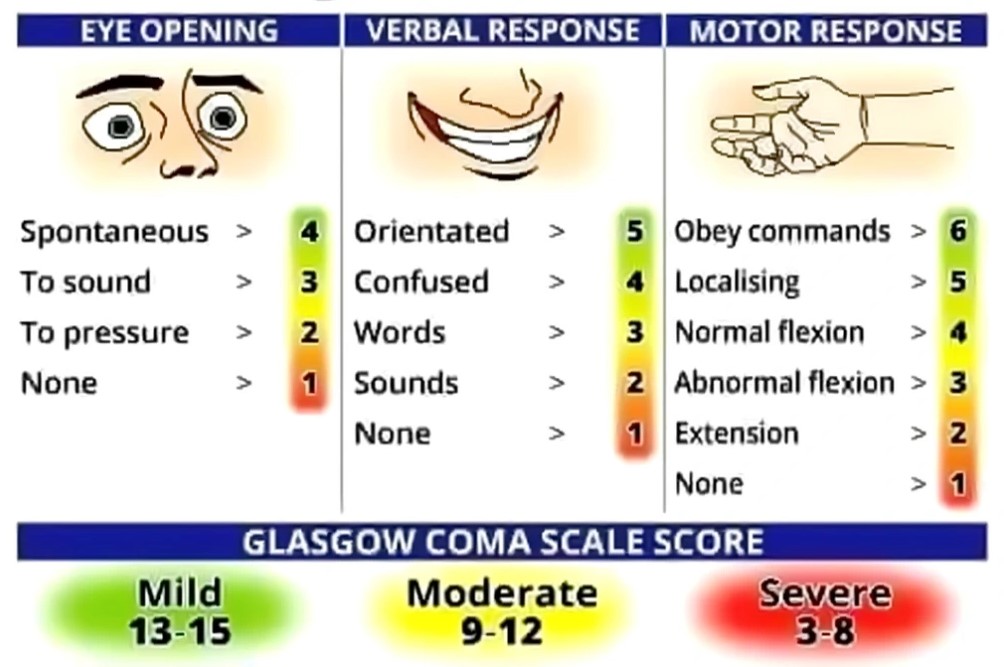
GCS uses a triple criteria scoring system, whereby the scores for each of the following criteria are added together to provide a single value between 3 (most severe) and 15 (normal).
- Eyes: minimum 1 point (no response), maximum 4 points (normal response)
- Verbal: minimum 1 point (no response), maximum 5 points (normal response)
- Motor: minimum 1 point (no response), maximum 6 points (normal response)
Eye Response
| CRITERION | RATING | SCORE |
|---|---|---|
| No opening at any time, no interfering factor | None | 1 |
| After fingertip stimulus | To pressure | 2 |
| After spoken or shouted request | To sound | 3 |
| Open before stimulus | Spontaneous | 4 |
Verbal Response
| CRITERION | RATING | SCORE |
|---|---|---|
| No audible response, no interfering factor | None | 1 |
| Only moans / groans | Sound | 2 |
| Intelligible single words | Words | 3 |
| Not orientated, but communication coherently | Confused | 4 |
| Correctly gives name, place and date | Orientated | 5 |
Motor Response
| CRITERION | RATING | SCORE |
|---|---|---|
| No movement in arms / legs, no interfering factor | None | 1 |
| Extends arm at elbow | Extension | 2 |
| Bends arm at elbow, features clearly predominantly abnormal | Abnormal flexion | 3 |
| Bends arm at elbow rapidly, but features not predominantly abnormal | Normal flexion | 4 |
| Brings hand above clavicle to stimulus on head neck | Localising | 5 |
| Obey two-part request | Obeys commands | 6 |